
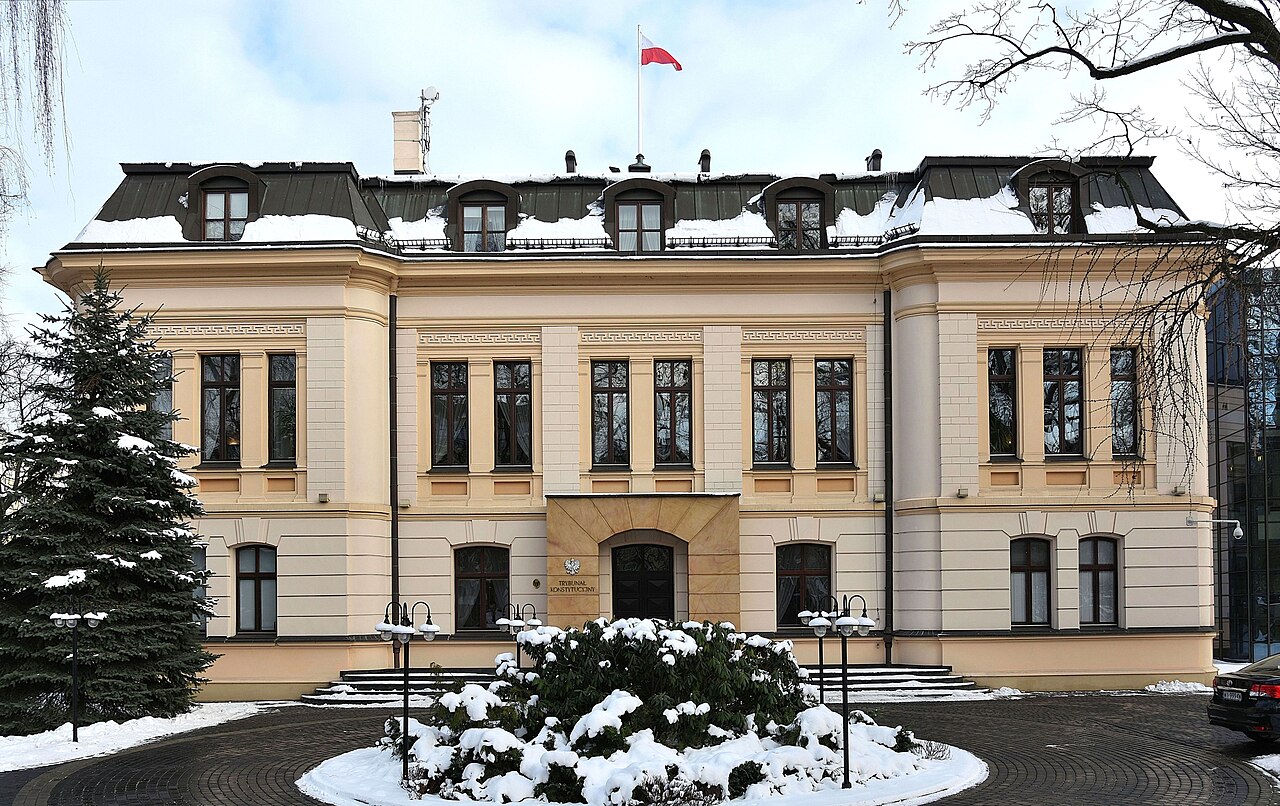
Poland was plunged into its most dramatic constitutional showdown in years on Friday night, as riot police sealed off the Constitutional Tribunal in Warsaw after its president was suspended, President Karol Nawrocki turned his plane around mid-flight, and the court’s own leadership branded the move a “coup d’état”.
The crisis pits Prime Minister Donald Tusk’s pro-European coalition against the conservative president and the opposition Law and Justice (PiS) party, in a long-running fight over who controls Poland’s top constitutional court.
What happened on Friday night
Judge Anna Korwin-Piotrowska announced that the Tribunal’s president, Bogdan Święczkowski, and its vice-president, Bartłomiej Sochański, had been suspended from their duties for one month, according to Euronews and the Associated Press. Korwin-Piotrowska is one of five judges chosen by the current parliamentary majority whose authority Święczkowski has refused to recognise.
AP reported that the suspensions rely on a provision allowing judges to be temporarily removed from duty, and that a disciplinary court must now review them and can either uphold or reverse them. At the same time, Justice Minister and Prosecutor General Waldemar Żurek said he had asked for the legal immunity of both men to be lifted, alleging that they had obstructed other judges.
The Tribunal’s official account on X hit back hard, saying Korwin-Piotrowska is not a judge of the court and that everyone involved was taking part in a coup. Some legal experts have also questioned the move: constitutional scholar Marcin Matczak argued, as reported by AP, that the minister’s supervisory powers over ordinary courts do not extend to the Tribunal, and that the law being used was written for ordinary courts.
Police, protesters and a president’s U-turn
As news spread, dozens of riot police were deployed at the Tribunal’s entrance and blocked access to the building. PiS supporters gathered outside, some chanting against Mr Tusk and others praying with rosaries. Ynetnews, citing Polish media, reported that some protesters tried to saw through security fencing so that Święczkowski could enter, and that he was filmed attempting to get back into the building before being stopped by police. Local police said three people were detained for throwing objects at officers. PiS leader Jarosław Kaczyński joined the demonstrators, AP reported.
President Nawrocki, a conservative aligned with PiS, was on his way to Senegal when the suspensions were announced. He cancelled the visit and ordered his plane back, writing on X that at a moment like this the president must be in Poland.
Mr Tusk backed the suspensions. In a post on X he described restoring the rule of law as a complex and sometimes painful process that requires decisive action. Former justice minister Zbigniew Ziobro, by contrast, denounced the suspensions as a criminal assault on the constitutional order and called for united, fearless resistance.
The US ambassador to Poland, Tom Rose, described the events as very serious, according to AP, warning that the protests had made an already dangerous situation more combustible and that the episode raised concerns about the independence of a key constitutional institution.
Why Poland is fighting over its top court
The dispute dates back to the PiS government of 2015 to 2023, whose judicial reforms were condemned by critics as a political takeover of the courts. The EU’s Court of Justice ruled that elements of those reforms broke EU law, and the bloc imposed financial penalties during a bitter standoff with Warsaw. Under PiS rule, the Tribunal itself ruled that Polish law took precedence over EU law in certain areas, a decision that alarmed Brussels.
Mr Tusk’s coalition came to power after the October 2023 election promising to undo those changes and repair relations with the EU. The current parliament has since chosen new Tribunal judges, but Mr Nawrocki and Mr Święczkowski have refused to swear them in, and the judges instead took their oaths in parliament. The government’s supporters see Friday’s move as a long-overdue step to restore a lawful court; the opposition sees an unconstitutional seizure of power. Each side accuses the other of breaking the constitution.
For Irish readers, the stakes go beyond Warsaw. Poland is one of the EU’s largest member states and a key voice on Ukraine and defence, and the rule of law within member states has been one of the most sensitive issues in Brussels for a decade.
What happens next
The immediate questions are whether a disciplinary court upholds or overturns the one-month suspensions, and whether the request to strip Święczkowski and Sochański of immunity goes ahead. With President Nawrocki back in the country, a direct confrontation between the presidency and the government is likely in the coming days. No formal EU reaction had been reported at the time of writing. Further protests by both camps are possible over the weekend.
Sources
- Euronews: Polish president turns back mid-flight amid court ‘coup d’état’ claims (30 October 2026)
- Associated Press via Yahoo News: Poland court suspensions spark protests, coup claims (31 October 2026)
- Ynetnews: Poland in chaos: Top court chief ‘suspended,’ police clash with protesters (30 October 2026)
- Times of Israel live blog: Poland suspends chief justice of constitutional court, sparking protests (30 October 2026)
Featured image: Trybunał Konstytucyjny zima 2016 by Adrian Grycuk, CC BY-SA 3.0 pl, via Wikimedia Commons.
Leave a Reply