
- What: Connemara West plc, a community-owned development company based in Letterfrack, north-west Connemara (connemarawest.ie).
- Founded: 1971, owned by about 500 local shareholder families who agreed from the start never to take a dividend.
- Base: The Connemara West Centre, in the buildings of the former St Joseph’s Industrial School, bought by the company in 1978.
- On campus: ATU Connemara (the national furniture design centre), Connemara Community Radio, Conservation Letterfrack, Youthreach and the Tigh na nÓg community crèche.
- Latest: A new five-year strategic plan was launched in Letterfrack in June 2025, focused on housing, education, jobs and sustainable tourism.
Drive through Letterfrack and it looks like most small Connemara villages: a crossroads, a few shops, Diamond Hill rising behind. But the stone buildings at the heart of the village hold one of Ireland’s longest-running experiments in community-led development. For more than five decades, Connemara West plc has used a company owned by local families to build tourist cottages, rescue a derelict institution, bring in a third-level college, put a radio station on air and build social housing.
Here is how it happened, what the company runs now and where it says it is going.
1971: nine thatched cottages and 500 families
A case study the company published in March 2020 says Connemara West was incorporated in December 1971 after a local fundraising drive. It was owned by around 500 shareholder families in the parish of Ballinakill. The first project was practical. The company built nine thatched holiday cottages at Tullycross, now the Renvyle Thatched Cottages, and ran them as a self-catering tourism business. Profits went back into community projects instead of out to shareholders.
That no-dividend rule has defined the company ever since. ThinkBusiness, Bank of Ireland’s business site, described Connemara West in 2020 as Ireland’s original social enterprise. It reported that the return for shareholders was meant to be the social, economic and cultural improvement of the area. An RTÉ Week In report from March 1980, republished by RTÉ Archives, showed the approach early on. It featured Michael O’Neill of Connemara West describing development that valued everyone in the area, including farmers and fishermen working flexible, seasonal hours. Michael O’Neill went on to publish a memoir of more than 60 years of community work in Connemara, which Galway Bay FM covered in September 2024.
The study-abroad link with the United States began in that first decade too. According to the case study, the company’s partnership with Aquinas College in Grand Rapids, Michigan, dates from 1973. In 2018 the two signed a memorandum marking 45 years of working together.
1978: taking on the industrial school
The company’s biggest decision came in 1978, when it bought the derelict St Joseph’s Industrial School in Letterfrack. The school had been founded in the 1880s and was run by the Christian Brothers until it closed in 1974. As the Irish Times has noted, its history includes the slow emergence of abuse of the boys held there. That history was examined in the 2009 report of the Commission to Inquire into Child Abuse. Connemara West spent years repairing the buildings, and they became the Connemara West Centre. Teach Ceoil, a centre for traditional music and the arts in nearby Tully, had opened a year earlier, in 1977.
The furniture college: from 1987 to ATU Connemara
In 1987 Connemara West began a partnership with what became the Galway-Mayo Institute of Technology to run a National Certificate in Furniture Design and Manufacture in Letterfrack. The company’s timeline says a €6 million building programme on the campus was completed around 2000. The new buildings, designed by architects O’Donnell + Tuomey, won the Downes Medal in 2001 and RIAI and RIBA awards in 2002.
Today the campus is ATU Connemara, part of the Atlantic Technological University. ATU describes it as the National Centre for Excellence in Furniture Design and Technology. It has more than 200 students on five degree programmes covering furniture, wood products and teacher education in design, graphics and construction. The campus library looks out on Diamond Hill, and the Wild Goat Café sits on site. A Citylink bus runs directly from Galway city.
Connemara Community Radio
The Connemara Community Radio group was also set up in 1987. It went on air for a short time in 1988, then became a licensed community radio pilot and has broadcast legally since 1 July 1995. Wikipedia lists its frequencies as 87.8 and 106.1 FM. The Galway Rural Development social enterprise directory says the station is based at the Connemara West Centre and has more than 100 volunteers working as presenters, technicians and correspondents. Its franchise area holds about 10,500 people, roughly doubling in summer. The station’s website is connemarafm.com.
Housing, childcare and sport
As the parish grew, the company turned to services that small rural places often lose. The 2020 case study records that Foscadh Community Development was formed in 1999 to deliver social housing, a community centre and sports facilities. Diamond Hill Housing Association followed in 2001, and the first social homes in Letterfrack were completed in 2016. A community crèche, Tigh na nÓg, opened in Letterfrack. A community astroturf pitch opened in 2012, and the Community Services and Leisure Centre was completed in 2019. The case study says more than 240 people worked for organisations on the Connemara West campus.
A thatched digital hub
Since 2012 the company has pursued what it calls an education-led strategy, aimed at a Global Learning and Digital Hub in Tullycross. A 2017 Fox 17 report said Aquinas College planned a $3.1 million privately funded education centre there. It would have an auditorium and study rooms, and the renovated cottages would house up to 40 students and staff. In July 2021 the Galway Advertiser reported that Connemara West had opened a pop-up remote working hub at the Renvyle Thatched Cottages. That was a stopgap while the wider hub project, funded by the Rural Regeneration and Development Fund and led by the Western Development Commission, was delayed by Covid-19.
What happens next
In June 2025 the company launched a new five-year strategic plan in Letterfrack. Galway Bay FM reported that Galway County Council Cathaoirleach Cllr Martina Kinane would launch it at the Wild Goat Café, followed by a campus tour and a family fun day on the green. The Connacht Tribune reported that the plan was shaped by residents, shareholders and stakeholders. Its priorities are sustainable development, inclusive housing, education, and growth in jobs and tourism. Chairman Dr Kevin Heanue described the plan as a clear mandate to act, and Cllr Kinane called the group proof of rural resilience.
The company held its AGM on 30 September 2025, according to its 2025 annual report listing. It turns 55 this December, and its model of patient, locally owned investment is worth studying for any rural community trying to keep young people, services and jobs. You can find out more at connemarawest.ie.
Sources
- Connemara West: Rural Development in North West Connemara (homepage) (accessed 31 October 2026)
- Connemara West: 1971–2020, Enabling a resilient community (case study PDF) (March 2020)
- Connemara West: Timeline of Key Events (accessed 31 October 2026)
- Connemara West: News (2018–2019 posts)
- ThinkBusiness: How Connemara West was the original social enterprise (16 September 2020)
- RTÉ Archives: Connemara community development (broadcast 10 March 1980; published 21 February 2020)
- Galway Bay FM: Iconic Connemara figure launches memoir (8 September 2024)
- Galway Bay FM: Connemara West to launch new strategic plan tomorrow (14 June 2025)
- Connacht Tribune: Connemara community charts a brighter future (June 2025)
- Atlantic Technological University: ATU Connemara campus (accessed 31 October 2026)
- Wikipedia: Connemara Community Radio (accessed 31 October 2026)
- Galway Rural Development: Connemara Community Radio (accessed 31 October 2026)
- Galway Advertiser: A hub with a thatch (29 July 2021)
- Fox 17: Aquinas College plans $3.1M educational center in Ireland (9 July 2017)
- The Irish Times: Living, working and playing in the glow of Diamond Mountain and the shadow of cruelty (18 August 2010)
- Wikipedia: Letterfrack (accessed 31 October 2026)
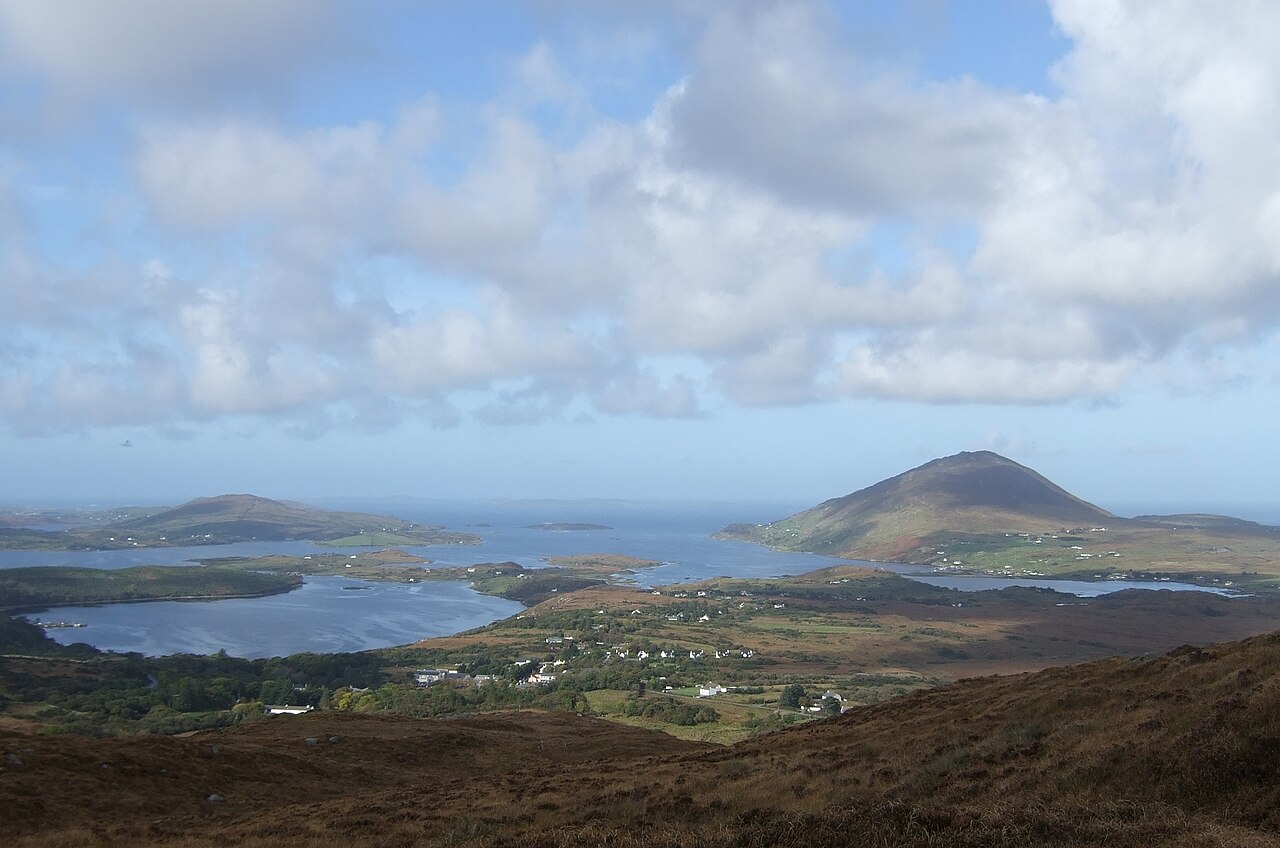
Featured image: Letterfrack, Connemara by Chalky Lives, CC BY-SA 2.0, via Wikimedia Commons.
Leave a Reply