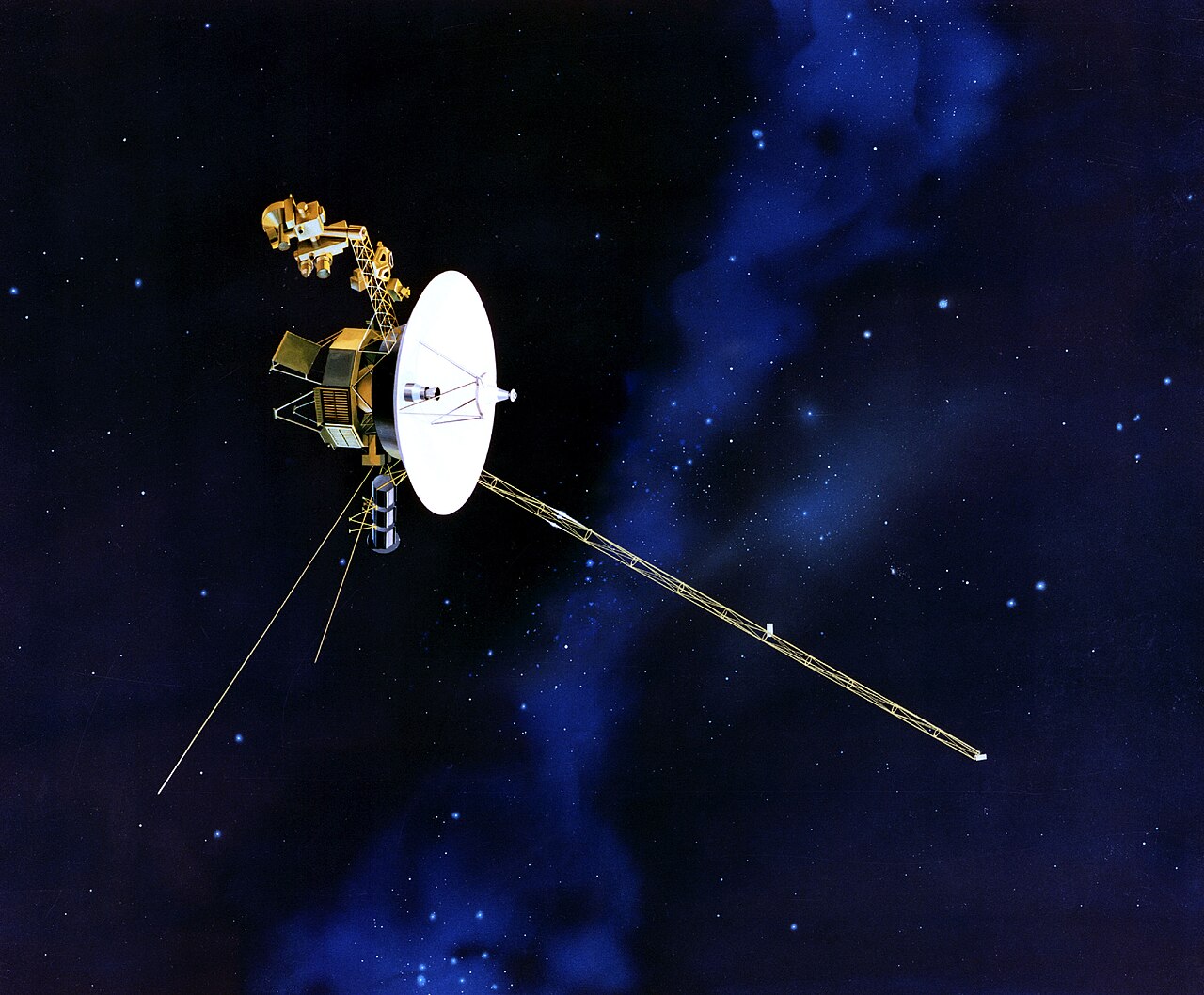
For two anxious days this month, the most distant human-made object in existence stopped answering. NASA has now revealed that Voyager 1, the probe launched in 1977 and now drifting through interstellar space, went quiet on 18 and 19 October before its signal reappeared on its own on 20 October.
Engineers have since worked out what happened, at least in part. And the episode has come just weeks before the veteran spacecraft reaches a remarkable symbolic milestone: one full light-day from Earth.
What went wrong
According to an update published by NASA on 29 October, the Deep Space Network, the agency’s global array of giant radio dishes, tried to pick up Voyager 1’s signal at two scheduled times 24 hours apart and heard nothing. At the time the probe was roughly 24 billion kilometres (about 16 billion miles) away.
The signal came back on 20 October, before the mission team had even sent any troubleshooting commands, and contact has continued since.
Engineers have established that one set of the spacecraft’s thrusters went offline and its backup thrusters took over. NASA said this is consistent with the probe’s “fault protection” kicking in, an automatic routine that puts the craft into a safe configuration and pauses normal operations when something looks wrong. What triggered it is still being investigated.
Mission manager Kareem Badaruddin told NASA it was “the first time we’ve seen the spacecraft do something like this”.
The ‘Big Bang’ power gamble
The blackout followed a delicate piece of engineering carried out on Voyager 1 in early September, which the team nicknamed the “Big Bang”. Engineers switched off three onboard devices and swapped in three lower-power alternatives all at once. The six devices involved help keep the spacecraft warm, so the swap had to happen simultaneously to ensure both lower power use and even heat distribution.
READ MORE
The same manoeuvre had been completed on Voyager 2 about six weeks earlier. NASA has not said that the September work caused the October silence; the cause of the thruster switch remains under investigation.
The stakes are high. Both Voyagers run on radioisotope thermoelectric generators, which turn heat from decaying plutonium into electricity. That supply shrinks by around 4 watts every year, leaving very little margin nearly half a century after launch. NASA said that without the power-saving swap, another of Voyager 1’s science instruments would probably have had to be switched off as early as summer 2027.
Voyager 1 left Earth with 10 dedicated science instruments. Several were turned off after its planetary flybys, and two more have been shut down in recent years to conserve power.
One light-day from home
Travelling at around 61,000 km/h (38,000 mph), Voyager 1 is about to pass a distance that is hard to get your head around. On 18 November it will be roughly 25.9 billion kilometres from Earth, which is one light-day. In plain terms, a radio message from mission control will take a full 24 hours to reach it, and the reply will take another 24 hours to come back.
Project manager Suzanne Dodd described the reality of that delay for the team: send a command and then wait two days for an answer.
NASA stressed that the milestone is purely symbolic. The spacecraft will not notice any change in its surroundings and nothing on board will be affected. But it underlines just how far this machine, built with 1970s technology, has travelled since it lifted off in September 1977.
Voyager 1 became the first spacecraft to reach interstellar space, crossing the boundary of the Sun’s protective bubble in August 2012. Its twin, Voyager 2, followed in November 2018.
What happens next
Engineers will keep digging into why the thrusters switched over and whether the fault could recur. With power falling every year, further shutdowns and glitches are likely as the mission ages, and specialist outlet Starlust reported that the team expects more surprises in the run-up to summer 2027.
For now, though, the oldest active deep-space mission is still talking to Earth, and on 18 November it will quietly cross the one light-day mark. Every extra month of science from interstellar space is, as the team sees it, a bonus.
Sources
- NASA Science: NASA’s Voyager 1 Conserves Power, Resolves Brief Communications Pause (29 October 2026)
- Starlust: Voyager 1 comes back online after mystery glitch in interstellar space (30 October 2026)
Featured image: Voyager spacecraft by NASA/JPL, Public domain, via Wikimedia Commons.