
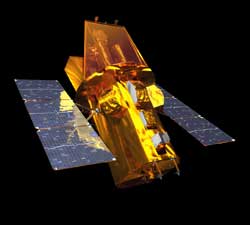
A 1.5-tonne NASA space telescope is set to come crashing back into Earth’s atmosphere within days, after a $30 million (about €26 million) robotic rescue mission went badly wrong over the summer.
The Neil Gehrels Swift Observatory, which spent more than two decades hunting the most violent explosions in the universe, is now dropping fast. Most of it is expected to burn up on the way down, but NASA has said some dense components could survive and reach the surface.
The good news for anyone in Ireland: we are well outside the danger zone.
When and where will it fall?
Nobody can say exactly yet. A US Space Force re-entry prediction issued on 1 November and published by tracking site KeepTrack gave a central estimate of around 00:30 UTC on Wednesday 4 November, but with an enormous uncertainty window, which means both the timing and the location are still loose. Newsweek, citing the US Space Force, reported the spacecraft was expected back “around Friday”. Forecasts like these usually only tighten in the final hours before re-entry.
What is known is the band of Earth that Swift flies over. Its orbit stays within about 21 degrees north and south of the equator, according to analysis reported by Space.com. That band is mostly ocean, but it also crosses populated parts of Africa, South and Southeast Asia, Central and South America and northern Australia. Ireland, at around 53 degrees north, never passes under its path.
By 31 October, the telescope had sunk to an orbit roughly 225 to 245 kilometres above the Earth, and it was losing several kilometres of height a day, according to KeepTrack’s analysis of the latest tracking data.
Should anyone be worried?
The risk to any individual is very small. Experts quoted by Space.com, including Darren McKnight of space-tracking firm LeoLabs, said the observatory should break up enough that it will not pose a meaningful casualty hazard, although some tougher parts of its X-ray and optical telescopes could survive. Engineer Dean Sladen said the heavy reaction wheels and parts such as mirrors and lenses were the likeliest survivors, and that any debris would most likely land in the sea.
NASA’s own rules cap the acceptable chance of a falling spacecraft injuring someone at one in 10,000. No detailed public risk assessment for Swift has been published.
How a rescue mission ended in failure
Swift launched in 2004 and quickly became one of astronomy’s great workhorses. It detected more than 2,000 gamma-ray bursts, the brightest blasts in the cosmos, and around 1,400 exploding stars, and acted as an early-warning system that tipped off bigger observatories such as Hubble and James Webb.
But spacecraft in low orbit are slowly dragged down by the thin upper atmosphere, and a recent burst of solar activity heated and puffed up that atmosphere, speeding Swift’s decline. In September 2025 NASA hired Arizona firm Katalyst Space Technologies on a $30 million contract to send a robotic servicer, called LINK, to grab Swift and push it into a higher orbit.
LINK launched on a Pegasus XL rocket on 3 July 2026, but within weeks it began tumbling after two of its three reaction wheels failed. NASA abandoned the capture attempt in August. By late October Swift was too low for stable observations and controllers shut down its systems.
What happens next
Space agencies and tracking firms will narrow the re-entry window over the coming days, and the final track should become clearer only hours before Swift hits the thicker atmosphere. If you are in Ireland, there is nothing to do but follow the story, and perhaps hope for a rare sighting video from the tropics if it streaks across the sky as a fireball.
If any debris does reach land, space agencies routinely advise people not to touch fragments and to report them to local authorities.
Sources
- Newsweek: NASA telescope could drop debris on Earth after failed rescue mission (31 October 2026)
- KeepTrack: SWIFT Reentry Watch as Gamma-Ray Observatory’s Orbit Decays (1 November 2026)
- Space.com (republished by NewsBeep): NASA’s Swift space telescope is about to crash to Earth. Where will it fall? (1 November 2026)
- Wikipedia: Swift boost mission (background, citing NASA, SpaceNews and Ars Technica) (accessed 2 November 2026)
Featured image: Swift spacecraft by NASA, Public domain, via Wikimedia Commons.
Leave a Reply