
Sixteen years after Ireland went cap in hand to Europe and the IMF, the State is preparing to pay back a large chunk of the bailout money ahead of schedule. Tánaiste and Minister for Finance Simon Harris has secured Cabinet approval for a plan allowing up to €8 billion of bailout loans to be repaid early. He says the move could save taxpayers as much as €90 million.
The loans in question come from the European Financial Stabilisation Mechanism (EFSM), one of the EU funds that propped up the country after the 2010 banking and fiscal collapse.
What the Government has agreed
Harris brought a memo to Cabinet last week giving the National Treasury Management Agency (NTMA), which manages the State’s debt, the option to repay the EFSM loans before they fall due. Ireland originally borrowed €22.5 billion under the mechanism and €15.3 billion is still outstanding, according to RTÉ. Reuters, in a report carried by the Irish Examiner, said that is just under half of what Ireland still owes European institutions.
Writing on his own Substack on 30 October, Harris said the loans were originally due to be repaid in the 2030s and described repayments of up to €8 billion taking place during 2027 and 2028, with the NTMA refinancing the debt. RTÉ, however, reported that payment was expected before the end of this year, after consultation with the European Commission. The exact timetable and mechanics are due to be set out “in the coming days”, RTÉ said, so the precise schedule remains to be confirmed.
The logic is simple: the State would replace older, more expensive borrowing with cheaper debt. Harris told Newstalk, as reported by Reuters, that “this will save money”. Speaking to RTÉ, he said the move showed how far the country had come and would be good for Ireland’s reputation as well as its finances.
Why Ireland can afford it
The plan is a sign of just how much the public finances have changed since the crash. The NTMA held €28 billion in cash and liquid assets at the end of September, according to Reuters, and the State has run budget surpluses in each of the past four years, driven largely by corporation tax paid by US multinationals.
The debt mountain has not disappeared, though. National debt stood at about €210 billion, or 63% of modified gross national income, at the end of 2025, Reuters reported, while RTÉ put it at €220 billion last month, citing the NTMA. A further €18.4 billion of bailout-era debt is still owed, according to the NTMA figures cited by RTÉ. Whether the €8 billion repayment actually reduces the headline debt will be a decision for the NTMA, since refinancing swaps one loan for another.
It would not be the first time Ireland has cleared bailout debt early. The State paid off the last of its IMF loans ahead of schedule nine years ago, according to Reuters.
What it means for you
Nobody will see €90 million arrive in their bank account. But every euro the State saves on interest is a euro that does not have to be found through taxes or cuts elsewhere. In context, €90 million is a small sum next to annual public spending of more than €100 billion, but it is roughly the kind of money that funds individual schemes and services.
For a generation that lived through austerity, the political symbolism is significant too: the Government is keen to show that the bailout era is firmly in the past. Critics are likely to argue that the bigger test for the public finances is how the State uses its surpluses on housing, infrastructure and the cost-of-living crisis, rather than shaving interest costs on old loans.
What happens next
The Department of Finance and the NTMA are expected to consult the European Commission before details are published. Watch for an announcement confirming how much will be repaid, when, and whether it will be funded from cash reserves or new borrowing. The NTMA’s decision on how the move affects the national debt figures will also be closely watched.
Sources
- RTÉ News: €8bn in bailout loans to be repaid early under Govt plans (29 October 2026)
- Irish Examiner (Reuters): Ireland plans to repay €8bn in bailout loans early to save on interest costs (29 October 2026)
- Simon Harris (Substack): Saving the taxpayer €90 million (30 October 2026)
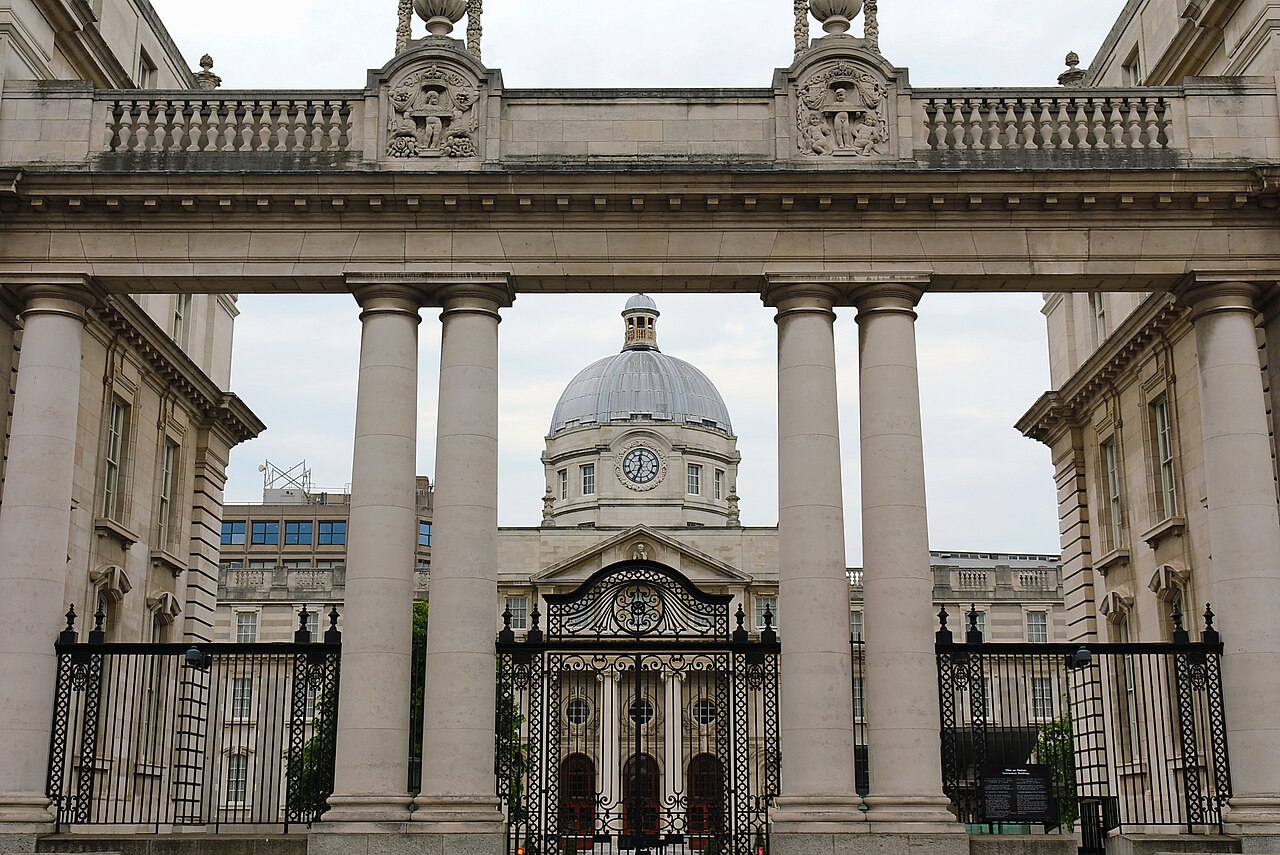
Featured image: Government Buildings, Merrion St Upper, Dublin (507053) (31252325261) by Robert Linsdell from St. Andrews, Canada, CC BY 2.0, via Wikimedia Commons.
Leave a Reply