
When the Veil Grew Thin: Samhain Comes Alive at Bearna Golf Club
Firelight, folklore and ancient ritual: Spás Studio and RISE AWILD summon the spirit of the old Celtic new year on the edge of Connemara
5 min read · Photography: Peter Harkin

The candles were lit. The fire crackled in the hearth. And as darkness settled over the bog and heather on the edge of Connemara, the oldest night of the Irish year came roaring back to life.
Spás Studio and RISE AWILD joined forces to host a spellbinding Samhain celebration at Bearna Golf Club, bringing together traditional Irish storytelling, music, movement and ritual for an evening that felt part theatre, part ceremony and part homecoming.
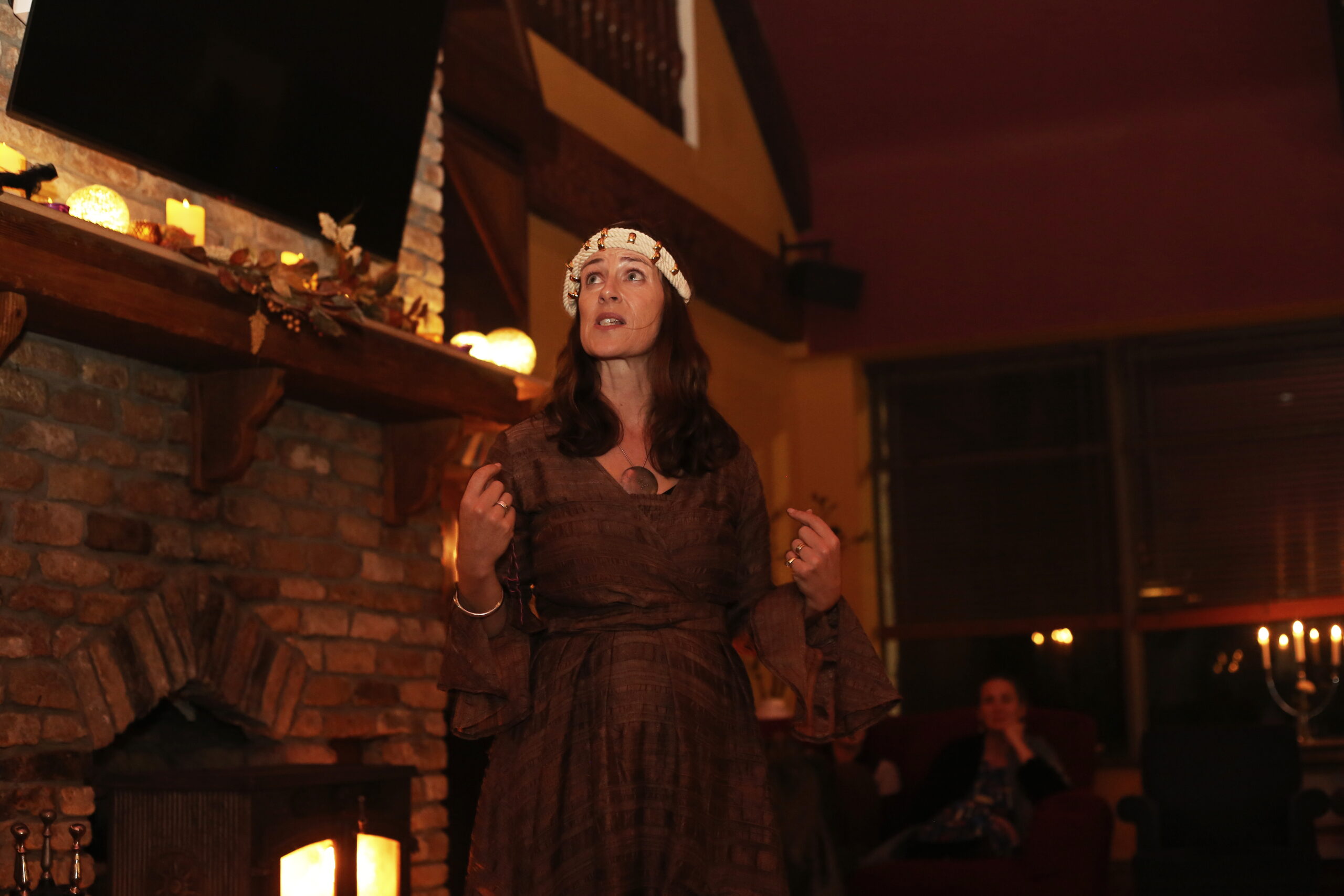
For one night, the clubhouse became a gathering place from another age. Candles flickered among garlands of autumn leaves along the mantel, and silver candelabras glinted in the half-light. Guests settled in by the bookshelves and leaned close to hear the old stories told again, just as people across the west of Ireland once did on the darkest nights of the year.
The night the dead came home
Samhain (pronounced SOW-in) was the great hinge of the Celtic year. It marked the end of the harvest, the bringing home of cattle from summer pasture, and the first night of winter, the dark half of the year. The Irish word for November is still Samhain.
It was also the most dangerous night of the year. On Samhain, our ancestors believed, the veil between this world and the Otherworld wore thin. The sídhe, the fairy host, rode out from the hills and raths, and the dead were said to walk home to the hearths they once knew.
Ireland’s landscape still holds the memory. At Tlachtga, the Hill of Ward in Co. Meath, great Samhain fires were said to be lit, with hearths across the land rekindled from the flame. In Roscommon, the cave of Oweynagat at Rathcroghan was long known as a gateway to the Otherworld, from which spirits and monsters poured out on Samhain night.
People hid behind masks and disguises so the wandering dead would not know them, and turnips were hollowed out and lit as lanterns. When Irish emigrants carried those customs across the Atlantic, the turnip became a pumpkin, and Samhain became the Halloween the whole world now knows.

Stories by the fireside
Those are the stories that once filled kitchens across Connemara through the long winter, passed from one generation to the next by the fire. At Bearna, they filled the room once more.
Facilitators Nicole O’Byrne, Eva Du and Bairbre De Barra of Gealán Dramaíocht guided the evening, weaving music, movement and ritual through the storytelling. Rather than sitting back and watching, guests were drawn into the night itself, with story, sound and movement working together in a way that felt both ancient and entirely of the moment.
For organiser Neasa Donnellan of Spás Studio, that sense of a living tradition is the whole point. The aim, she says, is “keeping our Irish cultural traditions alive in a contemporary way.”
It is an idea with real momentum. Across Ireland, artists, storytellers and community groups are reclaiming the old festivals, not as museum pieces, but as reasons to gather, to create and to mark the turning of the seasons together.
Horns, capes and a skeleton by the fire
Not every spirit in the room was solemn. Guests swept in wearing curling horns, flowing black capes and cat ears, candelabras held high, and one bony guest pulled up a seat by the fire for the photographs.
It was a playful reminder that so much of what we now call Halloween began right here. The costumes, the candlelit faces, the delicious thrill of the dark: all of it traces back to Samhain night, when dressing up was no party trick but a clever way to slip past the spirits unseen.


A setting fit for the old gods
Few venues could suit Samhain better. Bearna Golf Club sits at the gateway to Connemara in the Gaeltacht, around 8 km from Galway city. Established in 1996, its course was carved out of a classic Connemara landscape of granite rock, bog, gorse and heather, with commanding views across Galway Bay to the Burren and the Aran Islands.
By day, it is one of the most scenic courses in the west. By night, with the fire lit and the candles burning, it is not hard to imagine the sídhe riding across the bog outside. Inside, the glow of the hearth and the walls of books made a natural home for a night of stories, and a fine example of a local venue opening its doors to the arts.
The wheel keeps turning
Samhain is the first of Ireland’s four great seasonal festivals. Imbolc, Saint Brigid’s festival of returning light, follows on 1 February; Bealtaine welcomes the summer on 1 May; and Lúnasa celebrates the harvest on 1 August. Together, they once set the rhythm of life in rural Ireland.
Nights like this one at Bearna prove the old calendar has lost none of its power. In the darkest weeks of the year, it still gives us a reason to gather around a fire, light a candle against the dark, and tell the stories that made us.
Spás Studio is based at Bearna Golf Club, Co. Galway. Follow @spas.studio on Instagram so you don’t miss the next gathering.
For more stories from the west of Ireland and beyond, follow the Connemara Journal on Facebook.
All photographs by Peter Harkin.
Leave a Reply