
Halloween may be over, but the “Halloween fireballs” are not. This week brings one of the two peaks of the Taurid meteor shower, a close line-up of the Moon with Mars and Jupiter before dawn, and, by the weekend, the darkest skies of the month as the new Moon arrives.
With the clocks gone back and Ireland now on GMT, the times below are the same as Universal Time (UTC), which makes planning easy. All you need is a clear night, warm clothes and, ideally, a spot well away from street lights. Connemara and the west, with some of the darkest skies in the country, are ideal if the clouds co-operate.
Early this week: the Moon joins Mars and Jupiter
On the mornings of Monday 2 and Tuesday 3 November, look east and south-east before dawn. A waning Moon, just past last quarter, is moving through the constellation of Leo, close to the planets Mars and Jupiter and the bright star Regulus, according to astronomy app Star Walk. Jupiter will be the brightest point of light near the Moon, while Mars shows a faint orange tint.
On Tuesday morning the Moon slides very close to Regulus, and by Wednesday morning it forms a triangle with Jupiter and the star Algieba. No telescope is needed: these are naked-eye sights. Elsewhere on the planet the Moon will actually pass in front of Mars, Jupiter and Regulus, but those “occultations” are only visible from parts of the Pacific, Asia, Australia and South America, not from Ireland.
Midweek: Southern Taurid fireballs
The Southern Taurids are expected to peak around Wednesday night and Thursday, 4 to 5 November, according to both Star Walk and EarthSky. Don’t expect a storm. The Taurids are a gentle shower, typically producing about five meteors an hour, or around ten when the Northern and Southern branches overlap, as they do now.
What makes them special is quality, not quantity. Taurid meteors are slow and often bright, and a small share are fireballs, meteors brighter than the planet Venus. EarthSky puts that at about 1% in a typical year. The meteors come from debris shed by Comet Encke, which has the shortest orbit of any major comet, and the Earth passes through that dusty trail each autumn.
The best time to look is around midnight, when the shower’s radiant in the constellation Taurus is highest. The Moon rises in the small hours, so the hours before it comes up are your best window. Give your eyes 20 minutes to adjust, put the phone away and look at a wide stretch of sky rather than directly at Taurus.
Weekend: new Moon and dark skies
The Moon reaches new phase on Monday 9 November at around 7am Irish time, according to EarthSky. That means moonless nights at the end of this week and early next, perfect for picking out the Milky Way and the Andromeda Galaxy, the most distant object you can see with the naked eye, which sits high in the evening sky from Ireland at this time of year.
Planet-watchers hoping for Venus will be disappointed: the brilliant planet is very low in the dawn glow, and its close pairings with the Moon and the star Spica this week are rated poor viewing. Mercury passes between the Earth and the Sun on 4 November and is invisible.
What happens next
The Taurid season is not over after this week. The Northern Taurids peak around 12 November, and with the Moon only a thin crescent that sets early in the evening, the late-night viewing should be good. Royal Museums Greenwich says both branches are active well into November, and the Northern Taurids keep going into December.
If you’re hoping for a truly spectacular show, astronomers say the next predicted Taurid “swarm”, when the number of fireballs jumps, is not due until 2032. Until then, patience and a clear night are your best tools.
Sources
- Star Walk: Space Events Today: November 2-9, 2026 (30 October 2026)
- EarthSky: Taurid meteors: All you need to know (updated 1 November 2026)
- Royal Museums Greenwich: Taurid meteor shower: when and where to see it in the UK (accessed 2 November 2026)
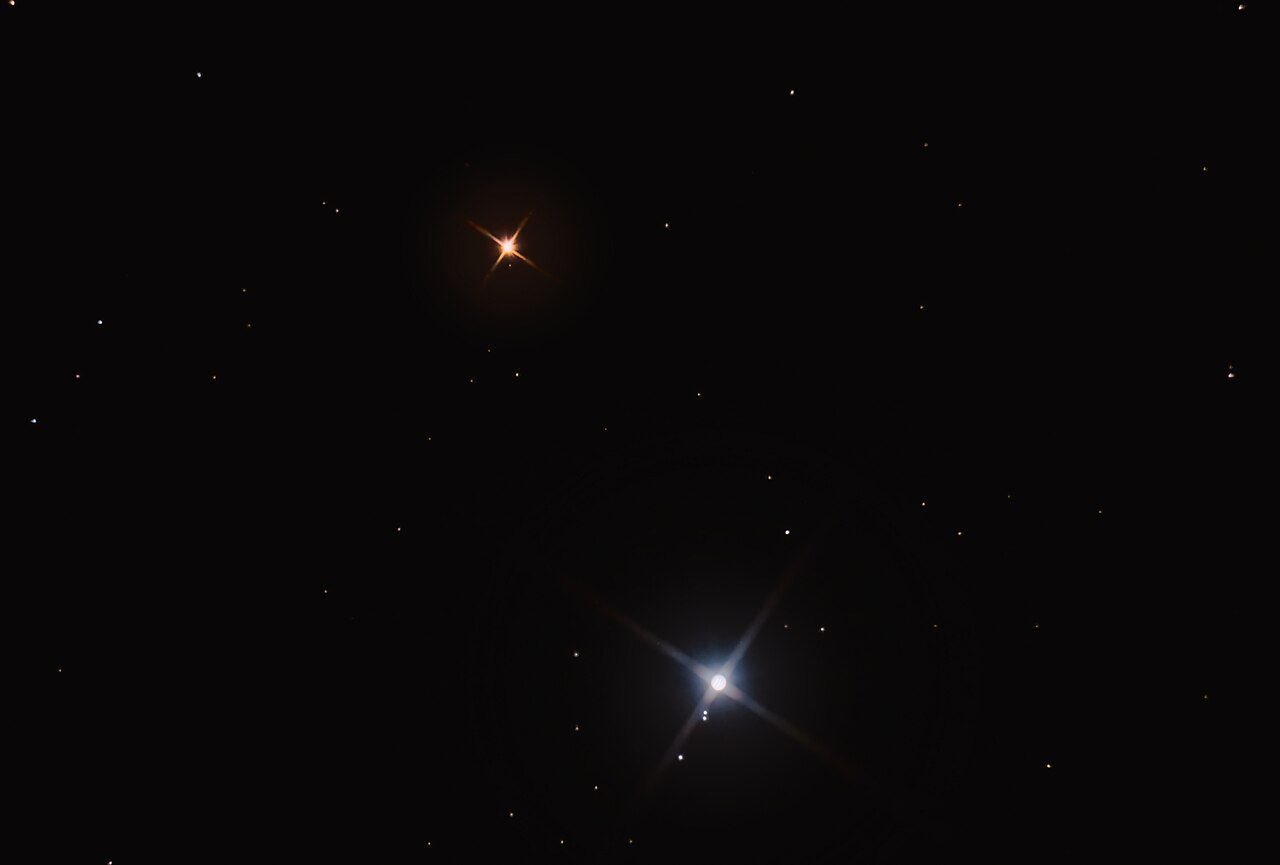
Featured image: Conjunction of Mars and Jupiter by Sebas FL, CC BY-SA 4.0, via Wikimedia Commons.
Leave a Reply